Saturday, 20 February 2016

One issue stories: Green Lantern #48


One of the biggest annoyances comic book fans can face is when a story is stretched out across many issues. This can leave readers frustrated by having to wait another month for the conclusion to a cliffhanger, having to buy so many issues to finish a story, or by pacing issues that can arise if a story is stretched out to last too long.

The one issue stories segment of this blog aim to look at stories that are neatly wrapped into one issue, so that anyone reading this blog can see where they can find a good story without having to buy too many comics.

Naturally I chose to start this segment with a comic that serves as the opening chapter in a three issue story, wait what?

Now I know I am probably losing but please allow me to explain before you comment or stop reading. Yes Green Lantern #48 is only part one of the three part "Emerald Twilight" story, but in my opinion #48 is not only much better than either #49 or #50 it actually works as its own story. In my opinion you can still enjoy a more or less complete story if you only read #50 (plus you get to avoid seeing Hal Jordan turn evil).

See? There is method to my seemingly complete lack of regard for my own segment topics.

Firstly I will start with some background.

As many people know Superman was killed off and brought back to life in the 92. What less people know however is that during the story arc that dealt with this series of events the hometown of Hal Jordan (Green Lantern) was destroyed by two of Superman's villains.

Green Lantern 48# picks up in the wake of this destruction. We open the comic to find Hal Jordan kneeling in the crater of what was once his home. Since Hal's ring gives him the power to create anything that he imagines he uses it in an attempt to restore his city and all of its former inhabitants. The majority of the issue focuses on Hal Jordan exploring the projection of the city that he has created and interacting with ghost like projections of people from his past.


There isn't any action in this issue, rather the issue is used to explore the thoughts and feelings of its central protagonist. I know that action is one of the main draws of superhero comics but sometimes it is nice to read a comic that serves as a breather between issues. Hal's feelings are made all the more relevant by the fact that his ring is powered and directed by his emotion (namely his willpower). It is in my opinion, an excellent study in the nature of grief and revisiting the past. In trying to bring back the home that he lost Hal is attempting something that we wish have wished we could do at one point or another. Hal finally says what he always wanted to say to his first love, he gets to have one more talk with his late father and get some answers on what his father would have thought of the man that Hal became.

In my opinion this issue could have been the foundation of a truly great story, and everything that is wrong Emerald Twilight is down to the two issues that follow.

Now it is true that Hal spends the last part of the issue already intending his infamous assault on the Green Lantern Corp, but I believe this would have been fine if #49 had gone a different way. When his ring runs out of juice Hal is brought painfully back into reality. He is immediately desperate to return to the world that he has created and he sees the Guardians as getting in the way of that. I believe that it is only fitting for the story that he would be a bit hostile at this point because he is essentially a wounded animal, trapped in his own pain. Had the following issues had him lose to the corps and be forced to come to terms with his loss the story would have been all the better for it.


Green Lantern #48 uses the abilities of its titular hero to explore upon feelings that will affect us all at some point or another throughout our lives. Hal struggles with his loss and tries in his own way to reconnect with the past. While his actions in the issues are not heroic they are certainly sympathetic.

All of this explains why Green Lantern #48 is good, but not quite why it deserves to be thought of as a single issue story. In order for that to be true it would have to have a beginning, a middle, and an end all in that issue and tell a complete story. So if we were to remove #49 and #50 what are we left with?

We have a story that starts with Hal's loss and his reaction to that loss. We move on to his attempts to process his grief and the story concludes when the he is interrupted by the outside world and finds that he is unable to cope. It isn't a happy ending but I maintain that that it has all the basic ingredients for a complete story. Admittedly it ends on a cliffhanger but I do not believe that fact is enough to disqualify it own its own.

Green Lantern #48 not only does justice to the universal themes that it explores, it does so in only one issue. That is why it is the first comic that I am recommending as a one shot story.


Friday, 1 January 2016

Why it's ok that Ben Parker, and the Waynes are perfect


One thing that long time comic book readers have probably noticed is how often the parents of superheroes are depicted as being perfect. This isn't always the case but often when a comic does focus on a superhero's parent(s) their flaws are ignored or not portrayed to the extent that you would be forgiven for thinking that they lacked any. 

You might think that I should be writing why this is a problem. Generally speaking characters who exist to be perfect are less interesting than their flawed counterparts. It is through a character's flaws that we see their struggles and their journey as characters. Character flaws also allow us to better relate to a character as we can see our flaws in them. 

So why am I in favour of a certain group of characters being without flaws? To answer that question I need to examine the roll that these characters play in the stories in which they appear. 

First I will look at the example of deceased 

I'm not saying that deceased characters should be perfect, in Harry Potter we only really start to see Dumbledore's flaws after his death and the reveals give us a greater appreciation of his character. The fact that these characters die as part of a backstory is key to my argument. 

Because the parents of superheroes often die in their offspring's backstory what we see of them is almost always through flashbacks or expanded backstory. This means that from a certain point on wards we are only experiencing these characters through the interpretation of their children. 

Take Thomas Wayne and Martha Wayne for example. Bruce Wayne's age is depicted as being anywhere from eight to twelve/thirteen when Thomas and Martha Wayne are killed in front of him. Because of this Bruce sees them the way he did when he was a child. Not only that but because he was only a child when it happened he would be getting a lot of his information on the type of people his parents were from stories about their actions or people who knew them personally. In the case of the former they will be stories deigned with certain angles in mind, and therefore not likely to give a fair and balanced fair of who the Waynes were. In the case of the latter he is unlikely to hear the negative aspects because the teller (say Alfred for argument's sake) aren't going to want to dwell on mistakes that the Waynes may have made because they were very dear to them, and they miss them. 

This aspect also explains why figures like Ben Parker are portrayed as perfect even though Parker is older than Bruce was when they wen't through their similar losses. In Parker's case he is going to want to focus on the positives of his uncle because that is naturally would he would focus on, and not just because of his feelings of guilt over the circumstances of his uncle's death. 

 "Everyday the future grows a little bit darker, but the past even the grimy bits, just keeps getting brighter" ~ Sally Jupiter, Watchmen
But what about living parental figures? The best character to use as an example for this is May Parker. In an event with Kevin Smith, Stan Lee said that he came up with the character of May to give Spider-Man someone to worry about. As readers we see May through the eyes of Spider-Man and this view is tinted by his worry and concern for her. This view of May is as complete as Bruce Wayne's view of his parents and isn't a full picture of who she is.

Spider-Man often worries about what would happen if May were to find out both the full circumstances of her late husband's death and his identity as Spider-Man. Yet in one comic she finds out both of those things and she is able to deal with them. Because she is much stronger than Spider-Man's fears allow him to give her credit for. This highlights the imperfect nature of the lens through which we perceive her character.

In Superhero comics parents and parental figures are often depicted as perfect. This is not however because their writers are lazy, or because the characters themselves are two dimensional. They are seen this way because we are witnessing these characters through the minds of their loved ones. In this capacity they serve as reflections of the hero's mental state. They show us what example the hero is trying to live up to, and also what they have lost or still fear to lose.


Sunday, 6 December 2015

Post mortem: Thomas Wayne of Earth 2 (New 52)


This article contains content that could be considered spoilers for  Earth 2 #1, Earth 2 Annual #2 and Convergence #3

One thing that we do not suffer a lack of in superhero comics is character deaths. It would be an exaggeration to say this is on the same level as, say Game of Thrones but they happen enough that a superhero dying has become a recognisable trend of comic books, especially in a big event.

The goal of a post mortem article is to look at character deaths in comic books and examine whether or not they were any good. It should be stated that I will not be looking at the merit of the stories that the deaths occur in, merely the deaths themselves. In my opinion there is no better way to illustrate that distinction than by looking at the death of Earth 2's (New 52) second Batman, Thomas Wayne.

The Thomas Wayne of Earth 2 was killed off in the third issue of recent mini series, Convergence. He dies fighting against various Batman villains from the pre-Flashpoint DC universe. He puts up a fight but is quickly overcome and sets off an explosion, killing the villains but also himself. In my opinion it is a fitting end for the character, one that brings his story threads to a natural end rather than disrupt them.

So why do I think this? The answer can be found in Thomas' back story.

Thomas' back story, as well as his motivation are explained in Earth 2 annual #2. In that issue the reader is shown that Thomas is a character defined by regret. Martha was murdered in front of Thomas and Bruce because of Thomas' connections to, and involvement with Gotham's organised crime (specifically the drugs trade). Batman chose a life as Batman, in part because Thomas faked his own death and Bruce did not find out that he survived the shooting until much later. Because of his decision to stay away from his son and pursue revenge his son disowned him when they were eventually reunited. To put it simply, every major decision Thomas Wayne made in his life only served to hurt, and fragment his family. He attended his son's wedding in secret and could only see Bruce and his family from afar. He was unable to make amends before Bruce's death in Earth 2#1. It is because of his regret that Thomas takes on the mantle of Batman. As a character he is defined by this regret. The character is so consumed by this desire to make amends that he uses Miracolo, effectively a superhuman steroid. The character has a history of drug addiction and is aware that Miracolo is a new addiction but claims he wouldn't be able to be Batman without it. Just like Bruce Wayne's Batman is consumed by his desire for vengeance, often at the cost of his own health, Thomas Wayne is consumed by a desire for redemption.

By the time of his death in Convergence 3# all of this issues have been resolved to one degree or another. Thomas Wayne's death in Convergence serves as a swan song to the character. Without any Miracolo to rely on he his forced to face overwhelming odds on his own strength and dies taking down a sizable chunk of Batman's pre Flashpoint rogues gallery with him. In this fight he is no longer a man seeking to wash away his mistakes as a husband and a father, but a man heroically defending his family.

Thomas Wayne's death also ties into the themes of the story in which it takes place. Convergence takes place in between the destruction of the old (New 52) Earth 2 and the establishment of the new Earth 2 that is the focus of Earth 2: Society. In this series Thomas serves as a brief mentor to Earth 2' Dick Grayson, who is inspired to take up the mantle of Batman after Thomas' death (Batmen drop like flies on Earth 2). Just as Convergence serves to bridge the gap between the original Earth 2 comic book series and Earth 2: Society, Thomas serves to bridge the gap between the original Earth 2 Batman and the new one. His death can be seen within a wider context of the last hurrah of the old series before the coming of the new series.

In my opinion killing off Thomas Wayne was not just a good way to end his story it was the most appropriate way to end his story. Both for the character, and the story. Unlike many character deaths which have been used for pure shock value or to raise the profile of a series Thomas' death genuinely serves the series in which it takes place.

Rather than close with a concluding argument I think I will let Dick Grayon's words from the comic itself explain why I believe the death to be such a fitting end for the character.


Friday, 20 March 2015

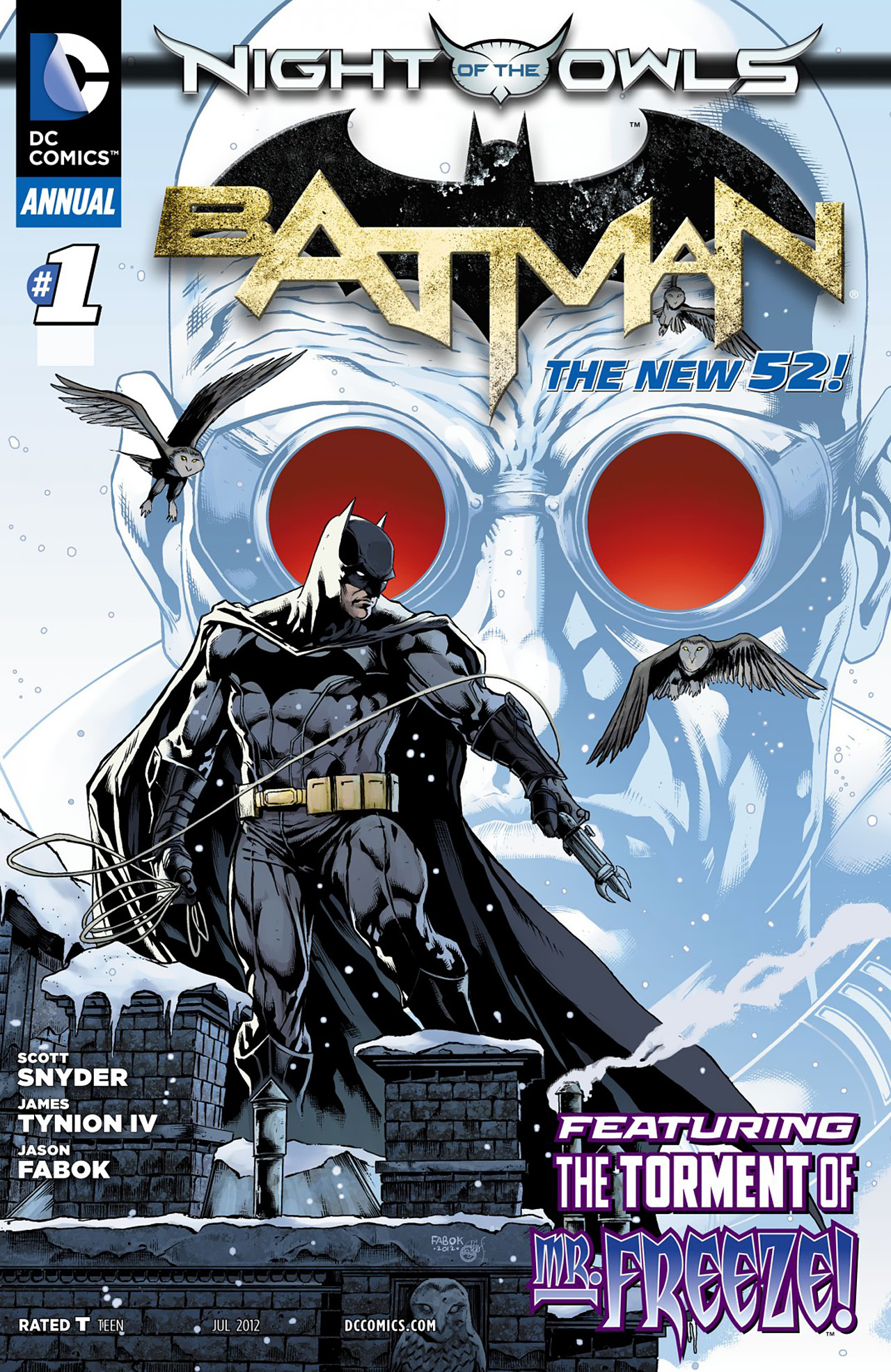
Why I actually like the new 52 version of Mr Freeze


As most of you reading this will know, a couple of years ago Mr. Freeze received a new origin by Batman writer Scott Snyder.

In the origin that started in Batman: The animated series Mr Freeze (real name Victor Fries) is a man who can only survive in sub zero temperatures. This came about due to a set of circumstances that involved his wife (Nora Fries), whom Fries put in suspended animation to prevent her illness from killing her before he could find a cure.

In the New 52 version Nora isn’t married to Mr Fries. In fact she was born and put in suspension decades before Victor was even born and they haven’t even met. Victor was working on finding a cure for her and became obsessed with her. When he was found out it led to the events that caused his current condition.

When news of this revised origin came out I didn’t want to read it. Obsessed man in love with a woman he has only ever seen in suspension removes a lot of tragedy from what was the story of a man so damaged in his attempts to save his wife. In my opinion this lack of a tragic element makes this new origin lesser in comparison, and if they were to put Mr Freeze in a new movie I hope that they go with the animated series version.

However, that being said I recently came to see the merit of the new version. In one of the later issues of Batman Eternal Mr Freeze uses his freezing device to create a tableau of the perfect family life. It was this scene that showed me the strength of the new origin story.

The problem with the animated series (as) Mr Freeze is that because all of his actions are for his wife it is too easy to stop conflict. When Mr Freeze is on a rampage all Batman needs to do is figure out if he wants revenge or medical supplies. If it is revenge Freeze wants Batman can bring the man to justice, if it is medical supplies then Batman can easily supply all that. At the end of Batman and Robin George Clooney’s Batman has Nora Fries moved to Arkham Asylum so that Mr Freeze can work on her condition while he resides there. With this action he has completely nullified the villain.

This might be good for a movie but it doesn’t work for a comic book. In a comic book the ideal is to have the villains able to return for as much as you want to use them. Earlier comic tales have killed off Nora Fries but this only causes a delay to the issue.  The problem of as Mr Freeze is that he has a logical finishing point. Either he gets to work on his wife and has need reason to harm anyone or he flames out getting revenge. Too many revenge stories would just see the character growing stale.

New 52 Freeze on the other hand, doesn’t have a logical end point. He believes that Nora is his wife and will kill anyone whom he deems to be coming between them. Unlike as Freeze there is no simply reasoning with this man.

His obsession also creates story possibilities that extend beyond Nora. A story could examine the route of his obsession (the issue that he was revealed in depicted him pushing his mother into a frozen lake because of the condition that a similar accident left her in). A story could show how he operates when he isn’t around Nora or what would happen if he were to make a connection with another person, and if such a thing would even be possible for his character.

I have loved the as Mr Freeze ever since I first saw his episode as a child and I still believe it to be the superior tale. The problem is that it just doesn’t work as a story that can be dragged out and re-examined in the way that a comic series requires. For this reason I have come to the belief that what Scott Snyder did in Batman Annual #1 was the right move for the character. While controversial, the new Mr Freeze has far more story potential than the old.


If you reacted like I did, and rejected the change I urge you to reconsider, and look at the New 52 version of the character with this perspective in mind.